
The foundation of everything .. The Working distance
Most dentists don’t realize their posture problems start with a measurement taken incorrectly at the beginning. It sounds simple but it’s one of the mos…
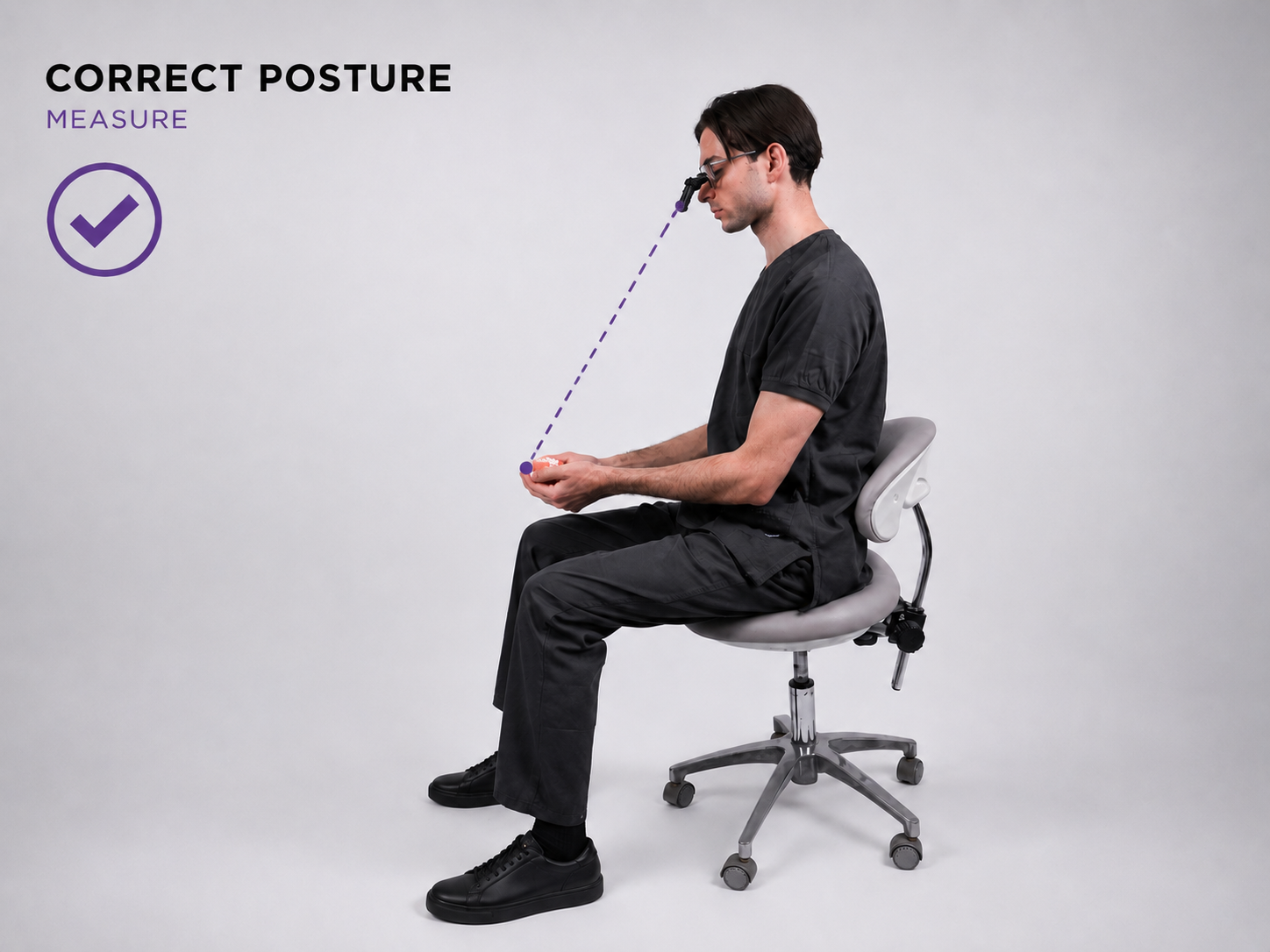
Most dentists don’t realize their posture problems start with a measurement taken incorrectly at the beginning. It sounds simple but it’s one of the most critical factors in loupe design. So what is working distance? Your working distance is the space between your eyes and the patient measured in real working posture. What happens when it’s wrong? ☞If it’s too short: You lean forward unconsciously Your neck and back compensate You lose ergonomic positioning ☞If it’s too long: You struggle to maintain clarity Your posture becomes unstable You lose precision in fine work What a correct working distance does ✅Keeps your spine neutral. ✅Aligns your head naturally over your shoulders. ✅Reduces long-term strain.
How to measure your working distance in clinic? The best way to measure working distance is not while standing straight or sitting casually. It should be measured in your real working posture. Here’s a simple clinical method: Step 1: Sit as you normally work Sit on your dental stool with your back relaxed, shoulders down, and feet stable. Do not force a “perfect posture” you cannot maintain during treatment. Step 2: Position the patient/mannequin Use a patient, mannequin, or phantom head in the same position you usually work with. The goal is to recreate your real clinical setup. Step 3: Find your natural head position Look toward the working area without leaning forward excessively. Your neck should feel neutral, not stretched or compressed. Step 4: Measure from your eyes to the working area Use a measuring tape from the outer corner of your eye area to the patient’s oral cavity or working point. This distance is your practical working distance. Step 5: Repeat in different positions Measure more than once: Upper arch position Lower arch position Direct vision Mirror vision Then use the average range, not one random number.
Written by MACTO Team · 14 May 2026
Loupes mentioned in this article